|
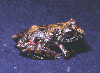
e. bicollor
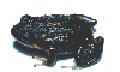
e. curtipes
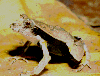
edalorhina-perezi
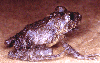
e-crenunguis
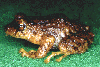
e-choloronotus
|
Accordingly, after finishing his M.S., he entered the University of Kansas
under the direction of William E. Duellman. In 1967, he made his first
trip to Ecuador, collecting in the Amazon lowlands part of the time and
in the Andes part of the time. A defining moment came when he had the
opportunity to collect at a mid-elevation cloud forest on the western
flank of the Andes. Here too was a fauna hardly known and while less diverse
than that of the lowlands, held a high proportion of frogs of the genus
Eleutherodactylus as well as frogs of the family Centrolenidae (glass
frogs). Between 1967 and 1978 he dedicated virtually all of his research
interests to Ecuadorian Eleutherodactylus and centrolenids. Describing
a great many species of each group. Beginning in 1976, he began to establish
contacts in Colombia because he was convinced that the Colombian fauna
was even more important and diverse than that of Ecuador. He began his
romance with Colombia in 1979, establishing contact with Cristina Ardila
and the late Pedro Ruiz. Ruiz and Lynch took and extended fieldtrip in
1980 to the highlands of Cauca and Huila with the result that the encountered
an astonishing 45 species of frogs above 2000 meters, of which half were
undescribed. That fieldtrip proved decisive because it demonstrated that
there existed a largely unknown frog fauna and because, during that fieldtrip,
Lynch and Ruiz mapped out a plan to conduct some 15 transects of the three
cordilleras. Over the next twelve years, jointly or individually, and
often with Cristina Ardila, they executed those transects and several
others. Those collections form the nucleus of the amphibian collection
of the Instituto de Ciencias Naturales and served as the source for the
many papers generated by M. C. Ardila, J. D. Lynch, and P. M. Ruiz. Between
them, they converted Colombia from an interesting tropical country to
the World´s country richest in frogs. For Lynch, the Colombian connection
became more and more important because it allowed him to focus upon his
major interests - historical biogeography and speciation - using frogs
of the genus Eleutherodactylus. In the past few years, he has begun to
accumulate sufficient data to confront these ancient questions in biology
and each year provides additional opportunities to confront these questions
and pose others. Between 1980 and 1996, he managed to visit and collect
in all mountain ranges of the country and to begin forays into several
lowland regions. In recent years, he has returned to the lowlands, so
as to complement the excellent collections of the Instituto de Ciencias
Naturales (ca 50,000 preserved amphibians, representing perhaps 80 % of
the species known to occur in the country). Lynch was a professor at the
University of Nebraska from 1969 until 1997 but, was always articulated
into tropical biology. At Nebraska, he also operated a research program
on fishes, driven by his interests in biogeography, studying the dispersal
of an introduced species and the consequences of its introduction on native
species. When the opportunity to enter the Universidad Nacional was presented
in 1997, his primary research interest won. After all, for several years
he had found it curious that he spent 9-10 months per year dreaming of
his friends and frogs in Colombia but only 2-3 months there. It was difficult
to leave friends (Royce and Ruth Ballinger, Bill and Linda Duellman, Tony
and Linda Joern, Arnold and Jean Kluge, Gerald Smith, Hobart Smith) and
family (Robert, Jennifer, and Paige Anders, Douglas Lynch) behind. During
his years working on the Ecuadorian fauna (1967-1978), he was a visitor
and left little behind, interacting primarily with campesinos. The Colombian
experience was very different. In Colombia, his primary contacts were
academics, who had a very different perspective from a campesino. Very
rapidly, a scientific exchange began with each side being very pleased
with the outcome. Such an exchange led quickly to scientific collaboration
and Lynch's cultural education. In 1985, he "discovered" the music of
the carrangueros, folklorists for Boyacá, and became enchanted with this
music, so different from his preferences for Chopin, Hayden, Liszt, Mendelssohn,
and Mozart. In 1992, he had the opportunity to meet Jorge Velosa and discover
the poet behind this popular music. Two years later, he named a pair of
frogs Eleutherodactylus carranguerorum and Eleutherodactylus jorgevelosai
to celebrate his intoxication with the music and the man. Little by little,
Lynch set roots in Colombia, roots that would lead eventually to his decision
to abandon the United States and move to Colombia. He counts four things
as especially precious and pleasing to him - his close friendship with
the late Pedro Ruiz, his friendship with don Jorge Velosa, his election
(1998) to the Academia Colombiana de Ciencias Exactas, Físicas y Naturales,
and the continued support of his children, Jennifer Anders and Douglas
Lynch, now a continent removed.

|